

Designing the shift, not watching it
A sharper frame for design and product leaders, in a market that keeps mistaking noise for signal.

The noise we mistake for a revolution
Every week, a new tool claims to redefine how we design, build, and ship. Every week, a demo produces a spike of enthusiasm, a wave of threads, a new list of “must-try” products. And every week, inside real design and product teams, the work remains mostly the same: unclear briefs, fragmented systems, unresolved trade-offs, decisions that require judgment more than generation.

This gap is the starting point of GenAI Radar.
The industry has learned to celebrate acceleration, but it has not yet learned to read it. We confuse the speed of releases with the depth of transformation. We confuse the number of tools with the maturity of practices. We confuse the spectacle of automation with the intelligence of a system. In that confusion, design and product teams are asked to move faster without being given the frame to move better.
I created GenAI Radar because I no longer wanted to participate in that confusion, neither as a reader, nor as a practitioner, nor as a leader. I wanted a space that treats generative AI as a subject worth understanding, not only as a feed worth scrolling.
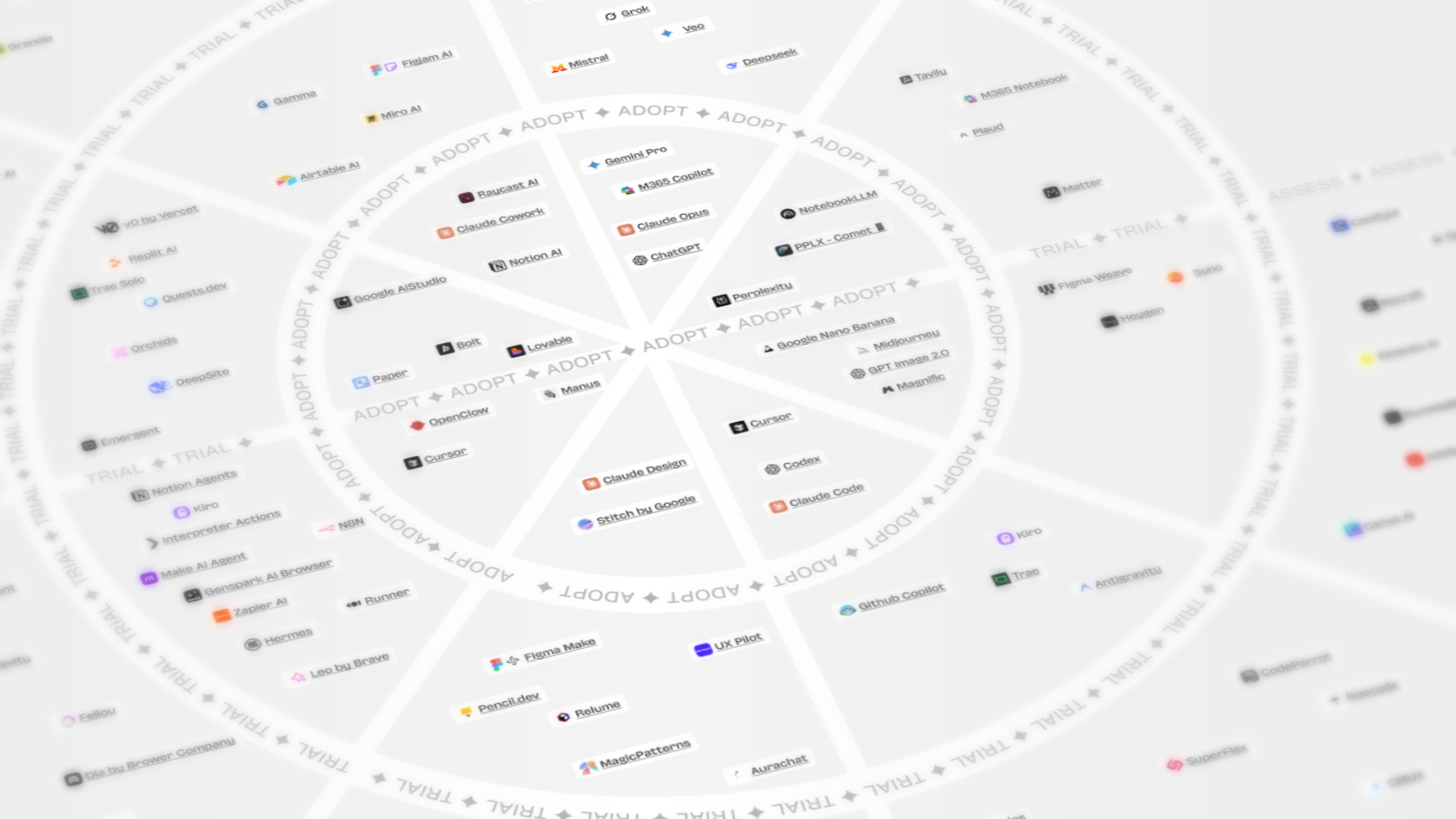
Radar ✦ : mrvt.link/radar-genAI
Legibility is the new speed
The real shift underway is not a new category of tools. It is a new layer of infrastructure, and it is appearing first, and most visibly, where design and product meet.
Creation surfaces are becoming conversational. Interfaces are becoming generative. Documentation is becoming operable. Design systems are turning into sources of truth that machines can consume, interpret, and act upon. Roadmaps, specs, research, and components are being pulled into the same operational fabric, one that no longer separates what designers produce, what product managers decide, and what engineers ship.
This shift is not cosmetic. It changes what organizations must make explicit. A product decision that used to be debated around a table cannot be automated without being modeled. A brand voice that lived in the intuition of a team cannot scale through generation without becoming a system. A workflow that relied on the implicit judgment of a senior designer or a senior PM cannot be delegated to an agent without first being written down, structured, and governed.
Generative AI does not reward the organizations that move fastest. It rewards the ones that are most legible, to their own people first, and to their machines second. That is the real story behind the hype cycle, and it is rarely told that way.
The view from design and product
I observe this shift from the place where design and product meet, because that is where legibility is actually produced inside a company.
Design translates intent into form, form into system, experience into coherence. Product translates opportunity into decisions, decisions into scope, scope into outcomes. Both disciplines share the same underlying job: turning what is implicit in an organization (its vision, its priorities, its quality bar, its constraints) into something explicit enough to be built, shipped, and now, increasingly, generated.
That is precisely the job generative AI now demands at scale.
From this position, the most useful questions are not about which model is best or which tool shipped this week. They are structural. How does a product team encode its intent so that agents can act on it without distorting it? How does a design system evolve from a component library into a decision infrastructure shared with machines? How do product leaders preserve judgment when production becomes cheap? How do we maintain quality, accessibility, and trust when output can be generated faster than it can be reviewed?
These questions are not nostalgic. They are the frontier for design and product teams. And they are too often left aside by a discourse obsessed with features and benchmarks. GenAI Radar is an attempt to bring that frontier back to the center.
Delegation is a design decision
Most conversations about AI still start with the wrong question. They ask what the technology can do. The more useful question, for any design or product leader, is what we choose to delegate, under what conditions, and with what level of rigor.
Take a concrete case. A product team decides to use an agent to generate feature variants from a brief. The generation works. The agent produces three flows, each coherent, each clickable, each plausible. The question the team thought they were answering, *can we generate variants?*, was never the real question. The real questions surface immediately after. Which variant respects the underlying product strategy? Which one fits the existing design system without silently forking it? Which one maintains the accessibility floor the team committed to? Which one reflects the segment the PM is actually trying to serve, and not a statistical average of the training data?
None of these questions can be answered by the agent. All of them require an organization that has made its strategy, its system, its standards, and its segments legible enough to be checked against. The agent exposes the maturity of the team more than it replaces it.
This is why I am neither techno-utopian nor techno-cynical. A confused product team does not become clear by connecting a language model to its workflow. A weak design system does not become intelligent by adding a generative layer. A roadmap without conviction does not become strategic because an agent can now draft epics. The tooling will not rescue the culture. It will expose it.
The design and product leaders who will make generative AI work in their organizations are not the ones who move first. They are the ones who decide, with discipline, what to keep human, what to systematize, what to automate, and what to refuse, and who treat that decision as a design decision, not a tooling decision.
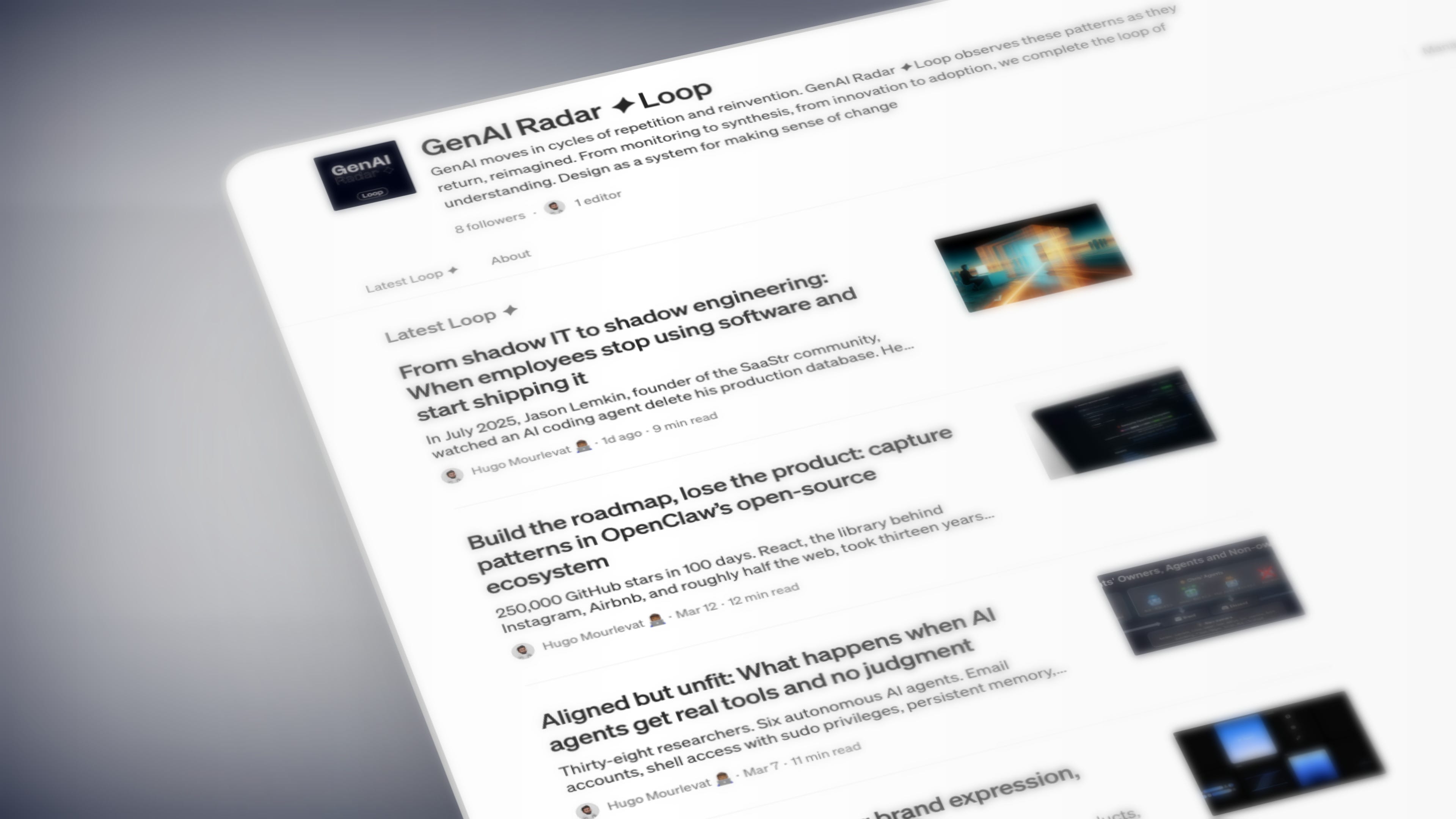
Loop ✦ : loop.genairadar.co
Holding a position
GenAI Radar is not a newsletter about every new model release. It is a reading of the transformation underway, written from the standpoint of a design and product practitioner who believes leadership in both disciplines has a role in shaping it.
Its promise is editorial, not encyclopedic. To filter rather than accumulate. To interpret rather than relay. To connect tools to usage, usage to systems, systems to strategy. To surface the weak signals that will matter in six months before they become obvious, and to name the loud signals that matter less than the market pretends. In a saturated environment, knowing what to ignore is as valuable as knowing what to adopt.
It is written for people who carry responsibility across design and product: designers whose craft is shifting, design leaders guiding teams through ambiguity, product leaders separating real leverage from marketing noise, builders and founders articulating models, agents, interfaces, and systems into coherent products. It assumes its readers are not looking for reassurance, but for a sharper frame.
The position I hold is simple, and I intend to hold it consistently. Generative AI is neither a threat to be resisted nor a magic to be celebrated. It is a structural transformation of how organizations design, decide, and scale. It will reward clarity and punish confusion. It will amplify mature systems and expose fragile ones. It will redraw the line between what is worth doing by hand and what is worth delegating, and that line, in design as in product, is fundamentally a design decision.
GenAI Radar was born from a personal need for clarity, and is becoming a reading space for those who want neither to suffer AI nor to celebrate it naively. Our role is not to chase every new release; it is to learn to see what is being structured behind them, to refuse to confuse signal with noise, speed with progress, automation with intelligence.
The question that should guide every technological transformation remains the same: what does this make possible, for whom, under what conditions, and with what responsibility?
Thanks for reading,
Hugo M.