

When AI manufactures the average, design takes the lead back
The iF Design Trend Report 2026 is out: iF International Forum Design and The Future:Project’s fifth collaboration, based on 10,000+ iF DESIGN AWARD entries from 70 countries.

🇫🇷 French version available on Linkedin
A report that forces a choice
What stayed with me isn’t the catalogue. It’s an implicit thesis I share: generative AI pushes practice toward an average optimized for likelihood. The phenomenon already has a name, popularized by Murrell, the Age of Average. High technology produces low distinction, and we, designers, are on the front line because our tools, our workflows and our aesthetics converge in parallel.

The classic trap would be to fight back. Banish the tools, slow down, defend a kind of purity. That’s not the road I’m taking. The useful question is elsewhere: when a tool averages everything, what stays irreducible? The signature. Not as a marketing posture, as a strategic asset. That idea runs through three trade-offs I’m holding on to. Step out of the average through signature. Choose where to install friction instead of taking it. Redefine our relationship to the living and the body. Three decisions that don’t get delegated, and that drive what I’ll be arbitrating in 2026.
A tension grid, not a trend ranking
I’m wary of trend reports in general. Too often they read like idea bingos that nobody knows how to act on. This one reconciled me with the format for one precise reason: it offers a tension model, not a ranking.
The principle is simple. Every societal challenge generates a trend and a counter-trend. Useful innovation comes from the friction between the two. Not from the dominant trend, not from the counter-movement, from their crossing. Six societal transformations structure the grid, four thematic pairs flow from it. The method combines two registers: statistics and survey results on one side, in-depth interviews with designers and design institutes on the other. The 10,000 projects entered to the iF DESIGN AWARD serve as the illustrative corpus.
What interests me here is the shift in posture. When you look at the world in pairs of tensions, you’re less concerned with betting on the “right” trend and more focused on recognizing the ones you accept to hold simultaneously, knowing that value comes from how you make them speak to each other. Not every brief gets the same treatment. On some, I’ll lean into ease of use. On others, I’ll deliberately put friction back in. This grid gives me the vocabulary to explain it internally.
Out of the Age of Average
The diagnosis, in numbers and honesty
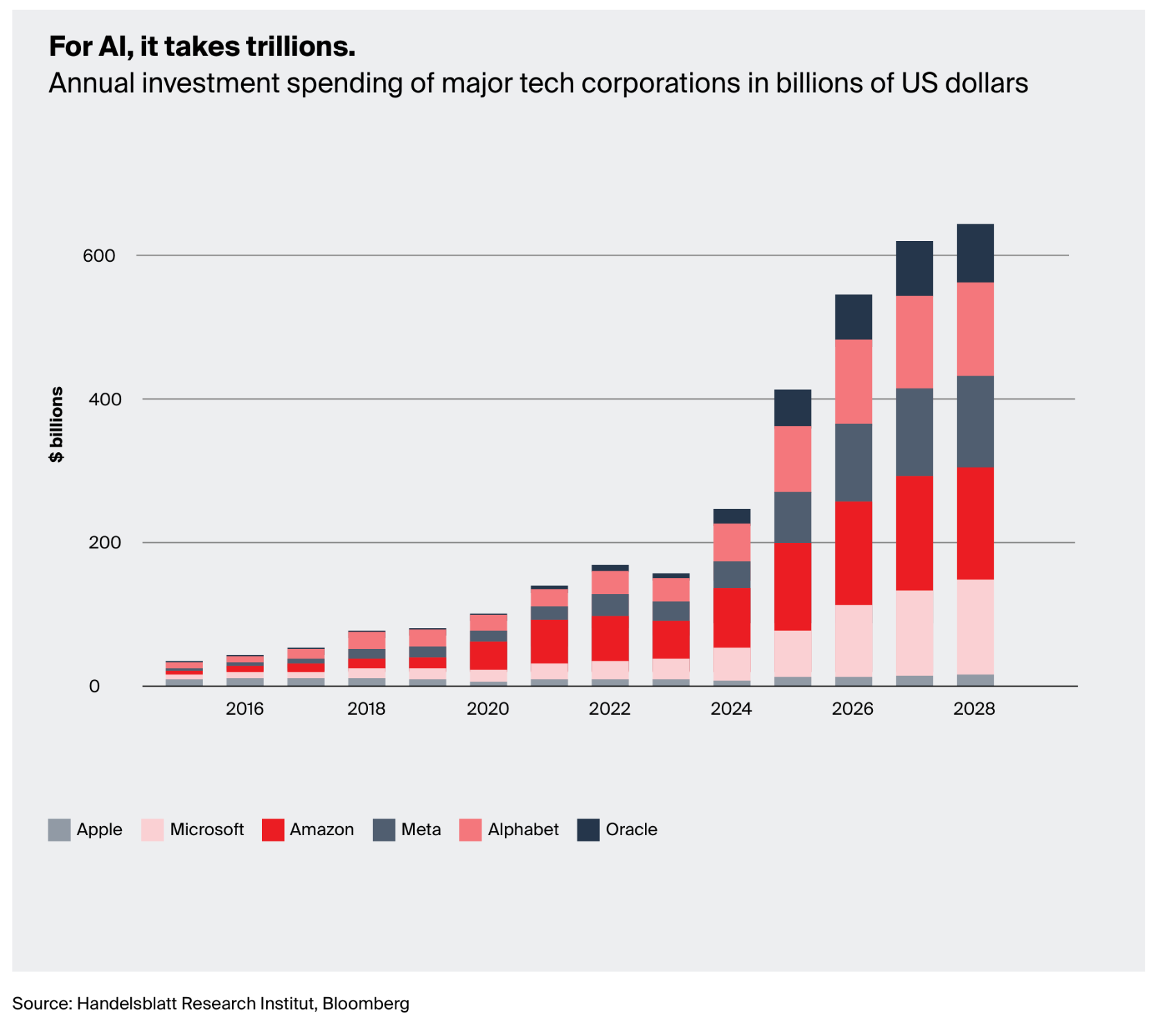
A curve makes the scale visible. Annual spend by Apple, Microsoft, Amazon, Meta, Alphabet and Oracle between 2016 and 2028, in billions of dollars. Sources Handelsblatt Research Institut and Bloomberg. The headline lands in four words: For AI, it takes trillions. The chart isn’t celebrating growth, it’s setting the order of magnitude. When numbers like these feed algorithms designed, by construction, to output the most probable result, you get a uniformization effect mechanically. AI didn’t invent the Age of Average. The phenomenon predates it, with the virality of memes and the consolidation of aesthetics. AI just amplifies it.
What I appreciate about the diagnosis is that it also names the legacies that make the situation hard to reverse. Three modern logics shaped our environment: scaling, efficiency, recognizability. They still structure cities, products, daily routines. For a design team, they create a double bind. Visual compatibility speeds up how a solution is read. The pressure to stand out in an attention economy has never been higher. AI sharpens that tension, because the easier an aesthetic is to reproduce and decline, the faster it becomes ordinary.
Out of the hype/disappointment binary
I started using one of the report’s frames in project committees right away: the tetralemma, inherited from Indian logic. Five positions instead of two. The first says AI will change everything. The second denies the promise, in the name of dehumanization. The third looks for compromise, “both A and not-A”. The fourth forces a shift, “neither A nor not-A”, reminding us that everything depends on context. The fifth, “something else”, opens a more radical question: the real issue is not what AI can do, but how we observe it, how we classify it, how we use it. An agile principle that product teams already know joins the table: fail fast, fail often, fail forward.
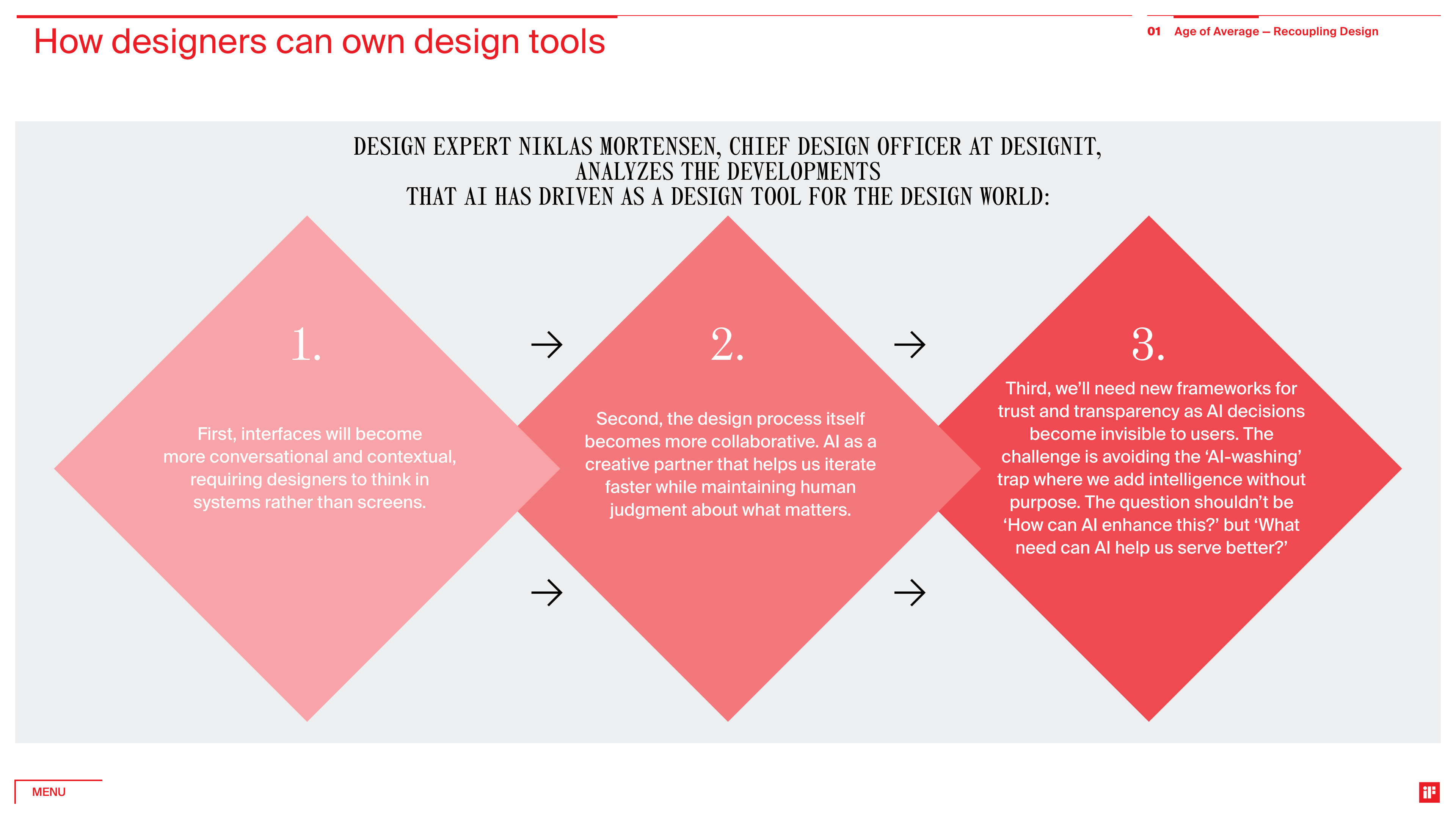
Niklas Mortensen, CDO at Designit, formulates the warning in three operational moves. Interfaces will become conversational and contextual, which forces designers to think in systems rather than screens. The design process becomes more collaborative, with AI playing the creative partner role and human judgment as the filter. And new frameworks for trust and transparency need to be built as AI decisions become invisible to users. The trap he names fits in two words, “AI-washing”, when intelligence gets added without serving a need. The reframing he proposes, the one I have stuck on the wall, fits in a single question: “What need can AI help us serve better?” You move from “how do we add AI” to “what need can AI help us serve better”.
Practices that resist the average
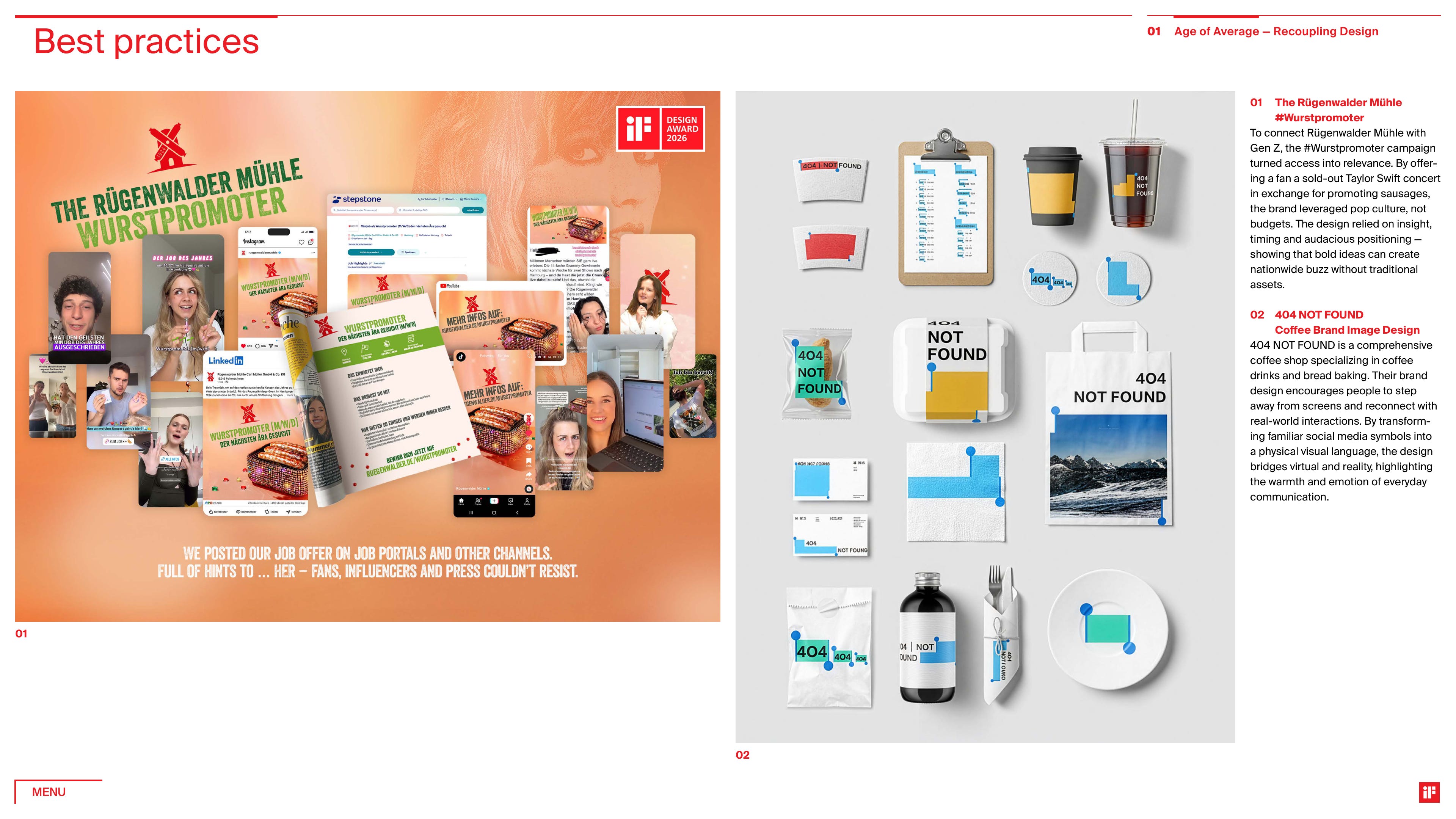
On the Age of Average side, where the mainstream is used with sharp intent, the #Wurstpromoter campaign by Rügenwalder Mühle connected the brand with Gen Z by trading a sold-out Taylor Swift concert ticket to a fan in exchange for promoting sausages. No outsized budget, just cultural instinct and an audacious position.
404 NOT FOUND, a coffee shop brand, turns familiar social media symbols into physical visual language to invite people back to disconnection. Pizza Prank made the 20% gender pay gap tangible by serving men 20% less pizza: visceral experience beats lecture.
On the Recoupling side, the examples rest on signature and chosen friction. FC Sans Pauli converts the rebellious spirit of FC St. Pauli into a typeface of seven styles, supporting more than 200 languages, with OpenType features. SEEN, titanium glasses with a transparent rim, project a rainbow onto the wearer’s face by light refraction, celebrating LGBTQ+ identity through light rather than words. Microsoft “Pride for each other” combines 73 LGBTQIA+ flags, reaches 95 markets and 2.4 million organic impressions.
AI itself can serve a signature, and several projects show it. Samsung Aura deploys an AURA Visual Branding System that goes beyond static guidelines by linking emotion, data and design into a self-evolving identity. Metamorphic UI turns transparent displays into living interfaces that adjust information density in real time according to gaze, position and context. Night Fishing, a ten-minute thriller shot with the IONIQ 5’s onboard cameras, opens up the Korean “Snack Movie” format and turns the vehicle itself into the production rig. Inspire AURORA installs ultra-HD LEDs and 3D media art across 6,053 m² to make the Northern Lights a sensory experience.
The “Perfect Flaw” as method
Branko Lukić’s interview is the passage that made me put the report down to take notes. Lukić reports having run more than 30,000 AI experiments. From that volume, he draws two propositions that landed for me right away.
The first: communicating with AI today looks like a 56k modem. “We do not need to protect ourselves from AI. We need to project and amplify ourselves through it.” No retreat, no shielding, conscious amplification.
The second proposition is conceptual: what distinguishes the human is not perfection, it’s the “Perfect Flaw”. The unique ways we process the world that produce original work. Lukić calls it the “Creative Fingerprint”. That fingerprint, he says, gets averaged out by default when you co-think with AI without naming it.
Lukić also shifts the vocabulary. Before co-creation, there is co-cognition, the way you think before you produce. “AI is like water. Our playbooks are ink.” The image is a diagnosis. At Logitech’s Creative and Design AI Lab, which he co-founded and which transformed the workflows of 250 designers, every practitioner ended up using AI differently, because the tool adapts to the user’s cognition. His conclusion on the interaction layer fits in five words: “We need to build it.” The last millimeter between human cognition and machine intelligence still has to be designed, and that is where the strategic edge sits.
The actual AI stack of designers: less hype, more discipline
Seven design experts from the panel list their tools. Bongkyu Song (BKID, Korea) works with ChatGPT, Midjourney, VISCOM and Magnific. Niklas Mortensen (Designit, Norway) sticks with Claude, Figma Make and Adobe Firefly. Patrizio Cionfoli (HAVELLS, India) uses Midjourney, Gamma and ChatGPT. Tiffany Chen (Airbnb) stays on ChatGPT and Google Gemini. Hokuto Ando (we+ Inc., Japan) names ChatGPT alone. Shikuan Chen (Compal Electronics, Taiwan) covers more ground: ChatGPT, Perplexity, Grok, Gemini, Claude. Dan Harden (Whipsaw, USA) describes a modular usage: pre-design concept for proposals, environmental context generation, sketch-to-render.
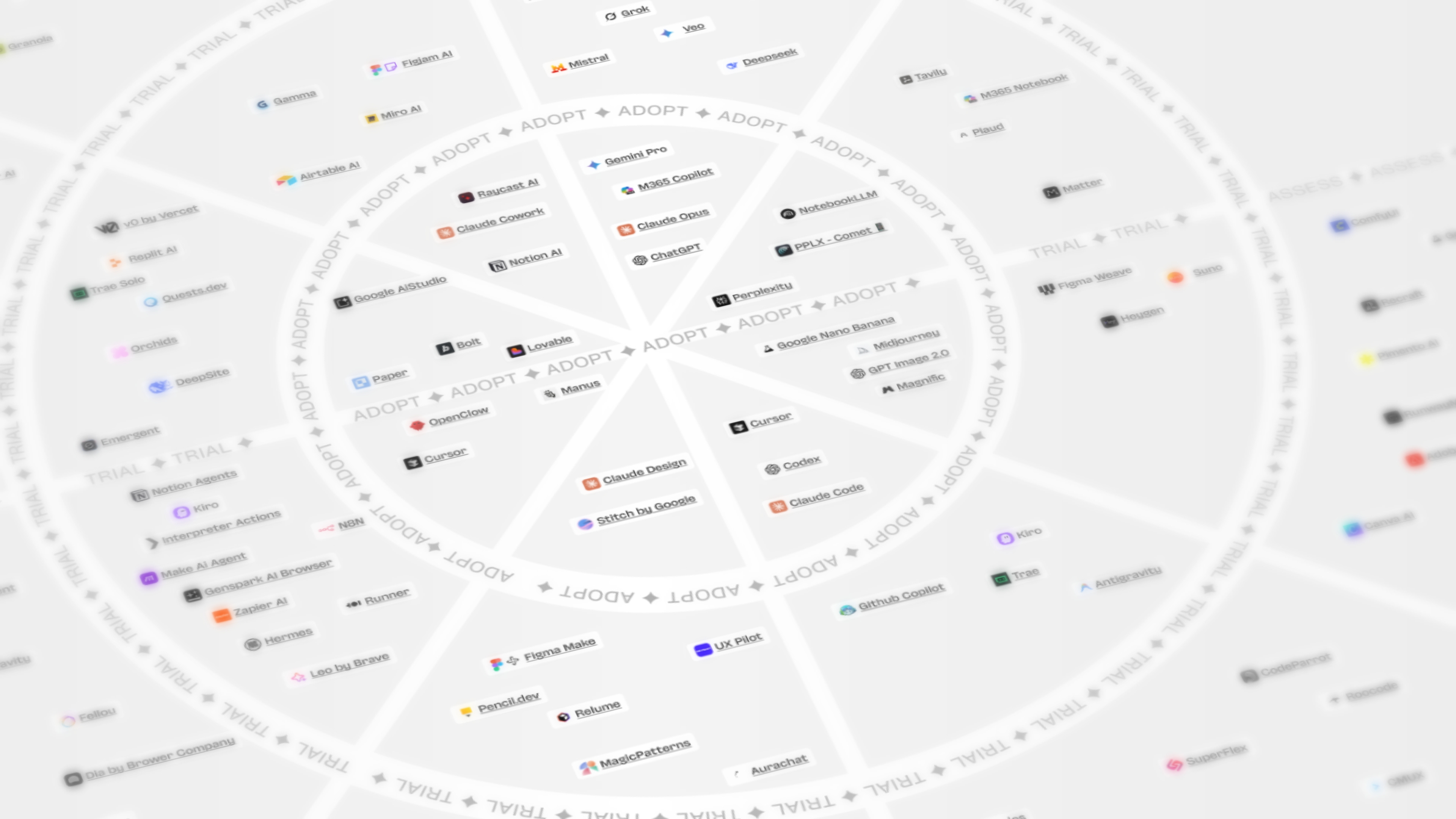
The gap with the media discourse is instructive. Convergence is already there, around a small core of ChatGPT, Midjourney, Claude and Gemini, regardless of market. Usage clusters upstream of the process: research, ideation, exploration of variants, exploration of materials. Tiffany Chen, at Airbnb, formulates the posture that strikes me as the healthiest: treat AI as a junior collaborator whose work needs review, not as a final authority. The concerns, in turn, are identical from one continent to another. Intellectual property, cultural bias, over-reliance, transparency toward users. The conviction that comes back the most is Mortensen’s: “Human creativity brings something AI fundamentally cannot: the ability to question the brief itself.” Human creativity brings something AI will not deliver, the capacity to question the brief itself.
If I had to summarize what I take away from all this, it would be four principles. The average becomes the default the moment you let go. Conscious deviation becomes a strategic advantage. AI surrealism is a creative booster if you claim it. Curation, selecting, rejecting, transforming, becomes the core skill. That is exactly the moment design takes the lead back.
Choosing where to install friction
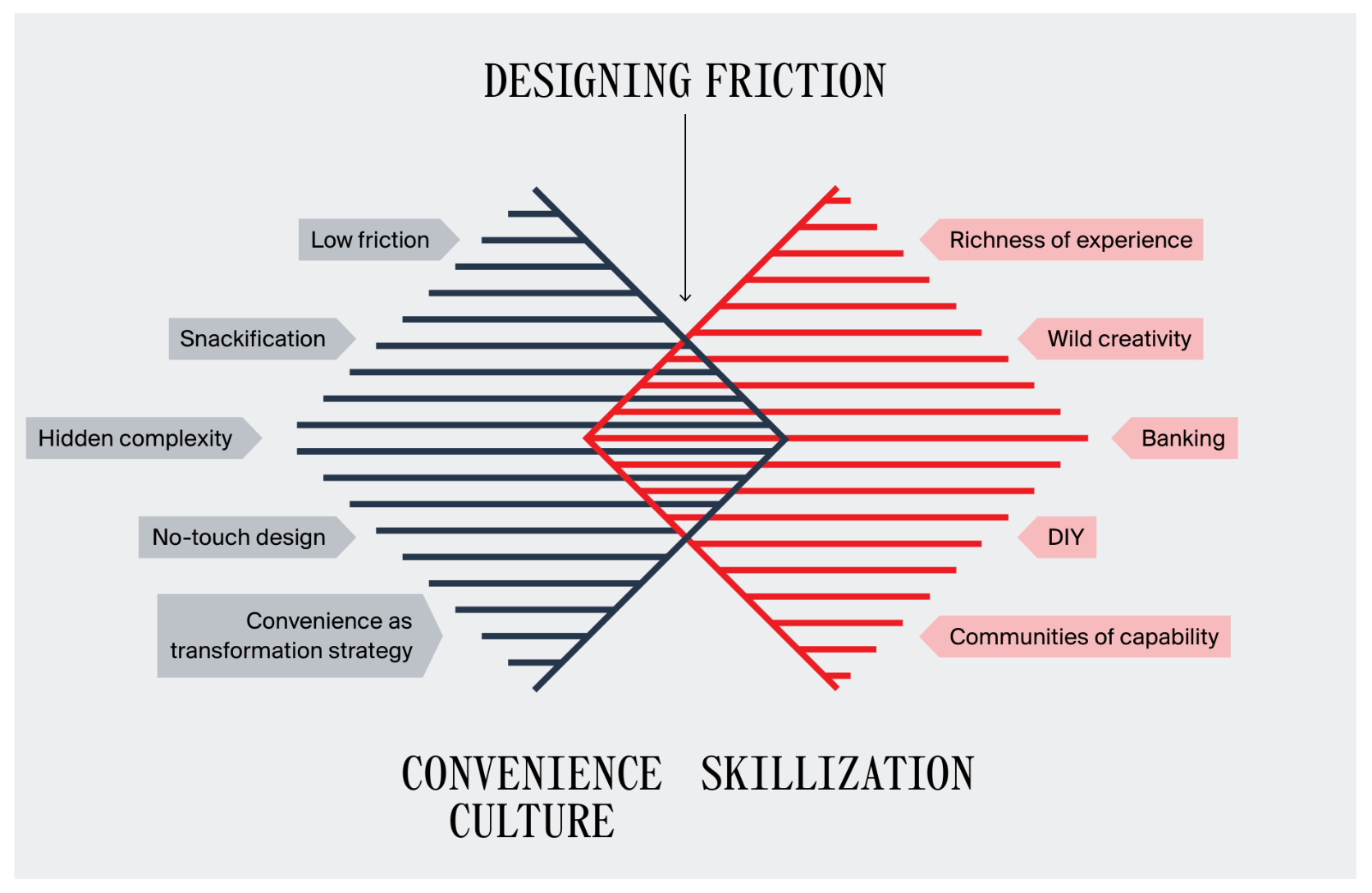
Second trade-off, where user culture pulls toward ease by default. Convenience Culture observes a drive for individuation that pushes to sand off any organizational effort. Skillization deliberately installs friction to bring out experience, mastery, identity. Designing friction, that is exactly the work my briefs ask for in 2026.
Four principles structure the Convenience side. Low Friction translates Csíkszentmihályi’s flow concept into a success metric, you minimize delays, hesitations, resistances. Snackification fragments experience into micro-moments that pace the day. Hidden Complexity hides functional complexity behind an intuitive surface, which raises the question of ethical legibility for the designer. No-touch Design removes tactile interfaces in favor of other modalities.
Tiffany Chen reframes the issue for me in one sentence: “Designing for convenience isn’t just about speed — it’s about making the better choice feel natural, supportive and optional.” The word that matters is optional. Convenience that removes the option is no longer design, it’s invisible coercion. On any onboarding flow, that is exactly the line to hold.
The counter-trend, Skillization, rests on three levers. Richness of Experience installs productive friction, the effort that makes an activity rewarding. Hackability of Products lets users modify, hijack, extend. Communities of Capability multiply peer-to-peer learning. The Tuuli, an electronic trombone integrating tactile feedback and intelligent systems, shows the category of instruments that learn within themselves.
The arbitration shows up in two concrete questions. On which flows should we accentuate convenience to free up time the user actually values? On which flows should we install friction that builds mastery and creates attachment? Neither pole is good or bad by default. The job is choosing the right friction, in the right place, for the right value. Convenience can also act as a transformation lever, a tool for durable behavioral change, provided it is used strategically and not out of design laziness.
Rethinking our relationship to the living and the body
Third trade-off, on a wider field. Next Nature reconfigures the human/nature relationship. Human Enhancement reconfigures the human/technology relationship applied to the body. Shaping relations: that’s the angle I find most useful for healthcare, wearable and built-environment briefs.
Next Nature is a transdisciplinary movement that replaces anthropocentrism with the integration of non-human intelligences and living systems into the design perimeter. Buildings, infrastructures and spaces become co-existing structures that take on ecological functions, climate regulation, water management, pollution cleanup. Technology is no longer opposed to nature, it connects with natural knowledge and traditional practices. Hokuto Ando, designer at we+ Inc. in Japan, sharpens the stake: “Next Nature interventions are less about offering technical fixes than about conducting cultural experiments that reframe the relationship between humans and nature.” The expected deliverable shifts. The output is no longer an object to optimize, it’s a cultural frame to put up for discussion.
On the body side, the report starts from an observation by Sigmund Freud. The human as a “god of prostheses”, who pushes natural capacities through technology and is reminded, with every step, of his own nature. Biotechnology, genomics, synthetic biology, robotics and data-driven medicine open three axes of expansion. Omniscience, unlimited knowledge. Omnipotence, infallible capacity. Omnipresence, visibility and presence everywhere. Shikuan Chen, SVP at Compal Electronics, places these ambitions as a recurring peak in the history of human aspiration.
Five operational lines structure the topic. Design creates meaning out of data, “from recording to categorizing, from measuring to reflecting”. The shift goes from control to care. Optimization and monitoring give way to motivation and wellbeing. Bodies become an interface, where materiality, comfort and symbolism govern usage. Enhancement makes norms negotiable, what counts as “normal”, “healthy” or “beautiful” becomes a social product designers contribute to shaping. And ethical guardrails are needed: modularity, reversibility, transparency, conscious limits. On a healthcare or wearable brief, these points form an implicit ethical specification. Modularity and reversibility, in particular, are choices of product architecture, not communication intentions.
Three decisions for 2026
One. Signature becomes a deliverable. Lukić calls it the Creative Fingerprint, Mortensen formulates it as the human capacity to question the brief. Concretely, it means writing into the design system, the onboarding and the client deliverables what I refuse to delegate to AI. Without that work, the “Perfect Flaw” gets averaged out by default, and the signature dies quietly.
Two. Friction is an instrument, not a defect. Friction of attention to escape the average. Friction of learning to generate mastery and attachment. Ethical friction to make trade-offs visible inside AI systems. My role is not to answer with reflex simplicity, it’s to arbitrate, project by project, where friction is productive and where it’s a cost.
Three. AI gets framed by the question, not by the tool. The stack of the designers interviewed shows the convergence is settled. The differentiator will not be in the choice of stack, it will be in the quality of the brief, the rigor of human critique and the strength of ethical guardrails. The useful posture for 2026 holds in two sentences. Tiffany Chen’s: treat AI as a junior collaborator whose work needs review. Lukić’s: don’t shield yourself from AI, amplify yourself through it.
When AI manufactures the average, design takes the lead back. Not by refusing the tool. By deciding what it doesn’t get to touch.
Thanks for reading,